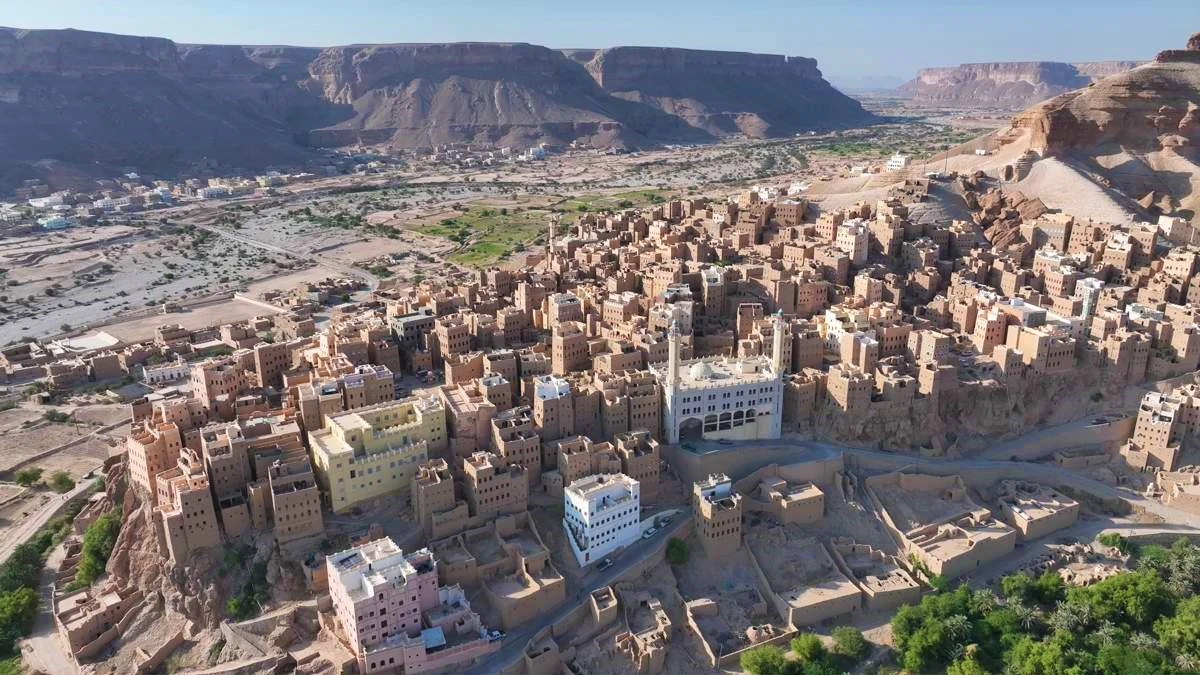
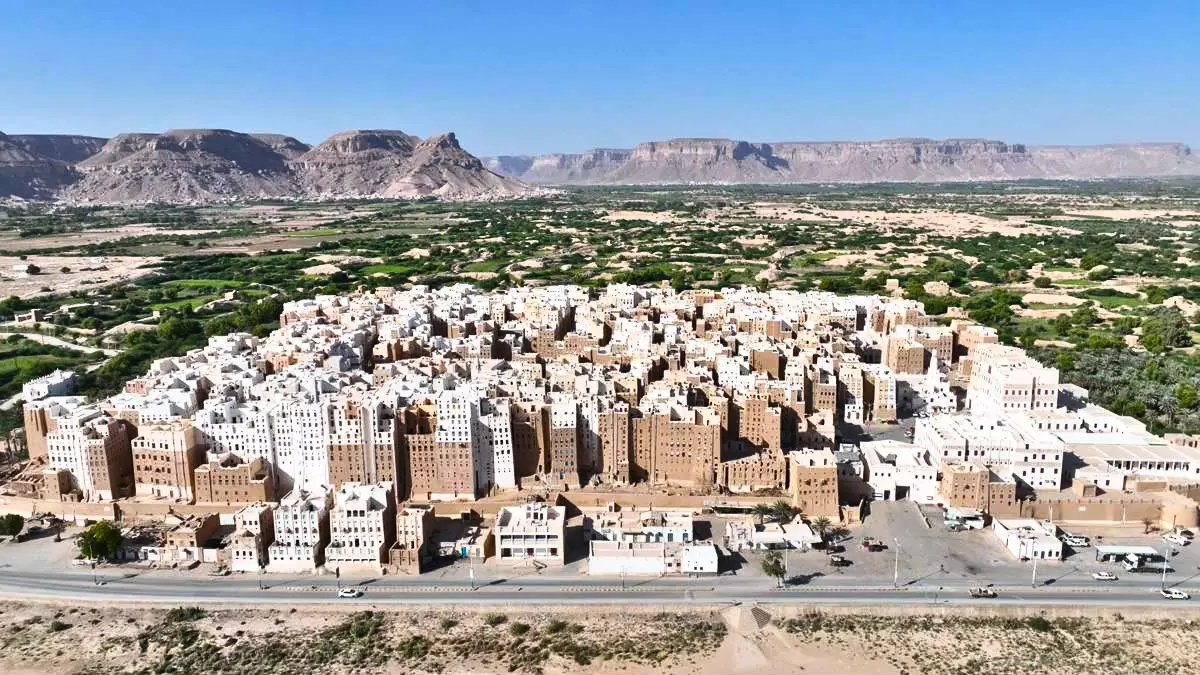
Rising above the floor of Wadi Hadhramaut, Shibam is one of Yemen's most extraordinary historic cities.
Its closely packed mud-brick tower houses form a vertical skyline that appears almost unexpectedly between the mountains, agricultural land and open valley.
These distinctive buildings are widely known as the Shibam skyscrapers and have earned the city its famous nickname, the Manhattan of the Desert.
The UNESCO-listed Old Walled City of Shibam is not simply a collection of old buildings. It is a complete historic urban environment shaped by defensive walls, narrow streets, family tower houses, religious buildings, local shops and the agricultural landscape surrounding the city.
Yemen has more than one historic place called Shibam.
This article focuses on Shibam Hadhramaut, located in Wadi Hadhramaut in southern Yemen. It is not the same place as Shibam Kawkaban, the historic highland settlement in northern Yemen near Sana'a.
For travelers interested in architecture, UNESCO heritage, photography and traditional Yemeni culture, Shibam Hadhramaut is one of the most important places to visit in Mainland Yemen.
What Makes Shibam Hadhramaut So Special?
Shibam is remarkable because its historic buildings rise vertically inside a compact fortified city.
Instead of spreading widely across the valley, residents built tall family houses close together within the city walls.
The result is a dense skyline of sun-dried mud-brick tower houses that looks very different from most other traditional settlements in the Arabian Peninsula.
From a distance, Shibam appears almost like a single architectural composition.
The walls, towers and closely grouped houses rise together above the surrounding land, while date palms, farms and the mountains of Wadi Hadhramaut form the background.
Inside the walls, the experience changes completely.
Visitors move through narrow streets and shaded passages between tall earthen buildings. Traditional doors, small windows, plaster details and local shops reveal the human scale behind the famous skyline.
This combination of a dramatic exterior view and an intimate interior environment is one of the main reasons Shibam deserves more than a short photography stop.
Why Is Shibam Called the Manhattan of the Desert?
Shibam is called the Manhattan of the Desert because its tightly grouped tower houses create a vertical skyline that resembles a miniature city of skyscrapers.
The comparison is visual rather than architectural.
Shibam's buildings are not modern towers made from steel, concrete and glass. They are traditional residential houses constructed mainly from sun-dried mud bricks.
However, when the city is viewed from outside its walls, the tall rectangular buildings rise closely beside one another in a way that immediately suggests a modern urban skyline.
The nickname helps travelers understand the visual impact of the city, but Shibam's real importance goes much deeper.
Its vertical construction reflects local history, family life, defensive needs, available land and generations of knowledge about building with earth.
The Manhattan of the Desert description may attract attention, but the city's Hadhrami architecture and living cultural heritage are what make it truly significant.
Are the Shibam Skyscrapers Really Skyscrapers?
The word skyscrapers is commonly used to describe Shibam's tall mud-brick buildings because of their height and the density of the city's skyline.
Architecturally, they are more accurately described as multi-storey tower houses.
These buildings were designed as family homes rather than modern commercial towers.
Their vertical form allowed families to live within the protected area of the walled city while making efficient use of limited space.
The phrase Shibam skyscrapers is therefore useful for describing the city to modern travelers, provided that the buildings are also explained within their correct historical and cultural context.
Shibam is often described as one of the world's earliest skyscraper cities.
The safest and most accurate interpretation is that it represents one of the oldest and best-preserved examples of urban planning based on vertical, multi-storey construction.
How Were the Shibam Skyscrapers Built?
The Shibam skyscrapers were built mainly from sun-dried mud bricks using local materials and traditional Hadhrami construction knowledge.
Mud-brick architecture may appear simple, but creating tall buildings from earth requires careful planning, suitable foundations, strong lower walls and an understanding of how weight should be distributed through the structure.
The lower parts of the tower houses are generally heavier and more substantial, while the building becomes lighter as it rises.
Wood is also used within the structures for floors, doors, windows and reinforcement.
The exterior surfaces require regular care because wind, rain and seasonal weather gradually affect the protective plaster.
Maintaining a mud-brick city is therefore an ongoing process rather than a one-time construction project.
The buildings survive because traditional skills are repeatedly applied by residents, craftspeople and conservation teams.
This relationship between architecture and regular maintenance is part of Shibam's living heritage.
Why Did the People of Shibam Build Upward?
Vertical construction offered several practical advantages.
Building upward allowed more families to live within the limited protected space inside the fortified walls.
The dense arrangement also supported the defensive character of the city.
Closely grouped houses, restricted ground-level openings and controlled access made the settlement more secure than a widely dispersed group of buildings.
The vertical plan also helped protect surrounding agricultural land from unnecessary urban expansion.
The relationship between the city and the fertile areas around it was essential because farming, water management and mud production were closely connected to everyday life.
Shibam's skyline was therefore not created simply to appear impressive.
It developed from the interaction between security, family organization, land use, climate, agriculture and local construction materials.
A Short History of Shibam Hadhramaut
The history of settlement at Shibam is much older than most of the buildings visible today.
The site has origins reaching back to the pre-Islamic period and later became an important political and commercial center within Hadhramaut.
Shibam became the capital of Hadhramaut after the earlier capital of Shabwa was destroyed in approximately AD 300.
Its position along historic trade routes helped connect the city with the movement of incense, spices, merchants and ideas across southern Arabia and beyond.
A major flood in the 16th century damaged an earlier settlement, and much of the urban form seen today developed after that period.
The surviving city therefore represents several layers of history.
Its mosque, castle, streets, walls and tower houses do not all belong to one exact date. Together, they show the gradual development of Shibam across many centuries.
During the 19th century, Hadhrami traders returning from Asia also contributed to the renewal of the city.
These international connections form part of the wider story of Hadhramaut, whose merchant families established important cultural and economic links with India, Indonesia, Singapore and other parts of the Indian Ocean world.
Is Shibam a UNESCO World Heritage Site?
Yes.
The Old Walled City of Shibam was inscribed on the UNESCO World Heritage List in 1982.
Its importance is based not only on the height of its mud-brick tower houses but also on the complete urban plan, defensive wall, streets, squares and relationship with the surrounding landscape.
Shibam represents an exceptional example of traditional Hadhrami urban architecture.
Its visual impact comes from the way the tall buildings rise from the edge of Wadi Hadhramaut and form a dense, unified skyline.
The city also reflects a traditional society that adapted to the environmental conditions of a large flood valley.
The historic buildings, agricultural areas, building materials and water systems were all connected.
Readers who want to explore the city's official heritage record can consult UNESCO's page for the Old Walled City of Shibam.
What Is It Like to Walk Inside the Old Walled City?
The view from outside Shibam is dramatic, but walking inside the walls provides a completely different experience.
The skyline disappears as visitors enter narrow streets surrounded by tall mud-brick facades.
The streets are compact, shaded and closely connected.
Traditional doors, small openings, passageways and changes in building height create a strong sense of enclosure.
Unlike an abandoned archaeological site, Shibam is connected to everyday local life.
Residents move between homes, mosques and shops, while traditional buildings continue to serve practical functions.
Walking slowly through the city allows travelers to notice details that cannot be seen from the panoramic viewpoint.
These include wooden doors, decorative plaster, building repairs, narrow stairways, street-level storage areas and the way sunlight enters the spaces between the houses.
The experience helps visitors understand that Shibam is not famous only because of its exterior appearance.
Its importance also comes from the relationship between architecture, family life and the organization of the city.
Can Travelers Go Inside a Shibam Tower House?
A visit inside a traditional tower house may be included when access and local permission are available.
This is one of the most valuable experiences in Shibam because it reveals how the buildings function vertically.
Different floors historically served different purposes.
Lower areas could be used for storage and practical household needs, while family living spaces occupied the upper levels.
Stairways connect the floors, and the rooms change as visitors move higher through the building.
When rooftop access is available, travelers can see the surrounding roofs, neighboring tower houses, agricultural land and mountains from within the city itself.
This view is very different from the external panoramic viewpoint.
Access to private or historic houses should never be assumed.
Visits must be arranged respectfully and may depend on the owner, local conditions and availability on the day.
What Are the Best Things to See in Shibam?
The Panoramic Shibam Viewpoint
The panoramic viewpoint outside the city provides the most complete view of the Shibam skyline.
From here, the mud-brick skyscrapers appear together as one vertical city rising above Wadi Hadhramaut.
Late-afternoon and sunset light often add depth to the facades and surrounding mountains.
On TourYemen's six-day Mainland Yemen itinerary, the viewpoint may be visited on the arrival day when the flight, airport procedures and remaining daylight allow.
This creates a memorable introduction before the detailed walking visit later in the journey.
The Streets of the Old Walled City
Walking inside the walls is essential for understanding Shibam beyond its skyline.
The narrow streets reveal the scale of the tower houses and the compact structure of the city.
Visitors can observe the relationship between homes, mosques, local shops and public spaces.
A Traditional Tower House
Entering a traditional tower house helps explain how Shibam's families lived vertically.
The internal visit also shows the thickness of the walls, the staircases, room arrangement and traditional building materials.
Rooftop access provides an additional perspective when it is available.
Local Antique and Handicraft Shops
Time to browse local antique and handicraft shops adds a human and commercial dimension to the visit.
Travelers should purchase responsibly and avoid buying any object that may have archaeological, religious or protected cultural value.
Locally produced handicrafts and clearly identified modern items are the most appropriate choices.
The City Wall and Gates
The fortified wall is fundamental to understanding why Shibam developed vertically.
The tower houses cannot be separated from the protected boundary that shaped the city's compact plan.
Observing the walls and access points helps explain the defensive logic behind the settlement.
What Is the Best Viewpoint for Photographing Shibam?
The strongest wide view is from outside the Old Walled City, where the complete skyline can be photographed against the mountains and valley.
Late-afternoon light is especially effective because it reveals the texture and different tones of the mud-brick facades.
A wide photograph shows the relationship between the city, agricultural land and Wadi Hadhramaut.
Closer photographs inside the walls should focus on architectural details such as doors, plasterwork, shaded passages, windows and the vertical lines between neighboring houses.
A rooftop view, when available, provides another valuable angle.
It shows that Shibam is not simply a flat wall of towers but a complex arrangement of roofs, homes, streets and open spaces.
Travelers should always ask permission before photographing residents, private homes or sensitive local situations.
Is Shibam Hadhramaut the Same as Shibam Kawkaban?
No.
Shibam Hadhramaut and Shibam Kawkaban are two different historic places in Yemen.
Shibam Hadhramaut is located in Wadi Hadhramaut in southern Yemen.
It is famous for its UNESCO-listed Old Walled City and dense skyline of mud-brick tower houses known as the Shibam skyscrapers.
Shibam Kawkaban is located in northern Yemen near Sana'a and is associated with the historic mountain settlement of Kawkaban.
Because both places include the name Shibam, travel articles, image captions and website content should use clear geographic descriptions to prevent confusion.
This article is entirely about Shibam Hadhramaut in southern Yemen.
How Does Shibam Fit into a Mainland Yemen Itinerary?
Shibam is one of the central experiences in a journey through Hadhramaut.
A well-planned route should not treat the city as one quick roadside stop.
TourYemen's six-day itinerary presents Shibam in two stages.
The first experience is a panoramic view of the skyline near sunset on the arrival day, when timing and daylight allow.
The second experience is a dedicated visit inside the Old Walled City.
Travelers walk through the streets, explore the mud-brick architecture, visit a traditional tower house when access is available and browse local shops.
After Shibam, the journey continues toward Al-Hajarayn and Wadi Doan.
This route creates a natural architectural progression.
Shibam introduces dense vertical urban construction, Al-Hajarayn presents a dramatic cliffside village and Wadi Doan expands the journey into a wider landscape of mud-brick settlements and mountain scenery.
Readers planning the complete route should also review the 6-Day Mainland Yemen Itinerary: Hadhramaut and Mukalla.
Should You Visit Shibam on a Group or Private Tour?
Shibam can be included in both a Mainland Yemen group tour and a Mainland Yemen private tour.
A group tour follows a confirmed route and schedule.
It is suitable for solo travelers and guests who prefer to share the journey with others.
A private tour offers greater flexibility with photography time, walking pace, viewpoints and the amount of time spent inside the city.
A Mainland Yemen Private Tour may be especially suitable for photographers, architects, researchers or travelers who want a slower and more detailed Shibam visit.
All visits remain subject to approved travel arrangements, local coordination, access conditions and the wider itinerary.
How Can Travelers Visit Shibam Hadhramaut?
Shibam is normally reached through Wadi Hadhramaut as part of an organized Mainland Yemen journey.
International travelers commonly arrive through Seiyun Airport and continue by road with their local team.
Travel arrangements generally require advance visa processing, security clearances, route approvals and local coordination.
Yemenia Airways reservations may also require local booking assistance because the relevant flights are not normally available through standard international booking websites.
Travelers should review the Yemen Tourist Visa Guide, Flights to Seiyun Guide and How Travel Works in Mainland Yemen before confirming their journey.
The practical arrangements should be completed before arrival rather than attempted after reaching Yemen.
Why Is Preserving Shibam So Important?
Mud-brick architecture is both strong and vulnerable.
The same earth-based materials that allowed Shibam to develop its unique skyline also require regular care.
Rain, flooding, erosion, drainage problems and unsuitable modern construction can all affect the historic buildings and surrounding urban environment.
Preservation is not limited to repairing individual facades.
It also involves protecting the city wall, streets, skyline, traditional construction knowledge and relationship between Shibam and the agricultural landscape of Wadi Hadhramaut.
Visitors can support responsible heritage tourism by respecting private homes, following local guidance, avoiding damage to buildings and purchasing appropriate locally made products.
Travel photography should celebrate the city without treating it merely as an abandoned or exotic backdrop.
Shibam remains meaningful because of the people, traditions and knowledge connected with its architecture.
Shibam Hadhramaut FAQ
Where Is Shibam Hadhramaut?
Shibam Hadhramaut is located in Wadi Hadhramaut in southern Yemen.
It is commonly visited as part of a Mainland Yemen route connecting Seiyun, Tarim, Wadi Doan and Mukalla.
Why Is Shibam Called the Manhattan of the Desert?
Shibam is called the Manhattan of the Desert because its closely grouped mud-brick tower houses create a vertical skyline resembling a miniature city of skyscrapers.
Is Shibam a UNESCO World Heritage Site?
Yes.
The Old Walled City of Shibam was inscribed on the UNESCO World Heritage List in 1982 for its urban planning, multi-storey architecture and relationship with the surrounding landscape.
How Old Is Shibam?
The history of settlement at Shibam reaches back to the pre-Islamic period.
Much of the city's present architectural character developed from the 16th century onward, although some important structures have earlier origins.
How Tall Are the Shibam Skyscrapers?
UNESCO's official description refers to dwellings reaching up to seven storeys.
The buildings vary in height and are more accurately described as traditional multi-storey tower houses.
Is Shibam the Oldest Skyscraper City in the World?
Shibam is frequently promoted as the world's oldest skyscraper city.
A more accurate description is that it is one of the oldest and best surviving examples of urban planning based on vertical, multi-storey construction.
Can Visitors Enter the Shibam Tower Houses?
A traditional tower-house visit may be arranged when permission and access are available.
The visit should be treated respectfully because many buildings are connected to local families and everyday life.
What Is the Best Time to Visit Shibam?
TourYemen generally recommends visiting Mainland Yemen between mid-September and April, when conditions are more comfortable for walking and outdoor sightseeing.
The exact experience depends on the month, daily temperatures and travel arrangements.
How Much Time Should Travelers Spend in Shibam?
Travelers should allow dedicated time to walk inside the Old Walled City rather than stopping only at the exterior viewpoint.
The strongest experience combines a panoramic skyline view with a separate detailed visit through the streets and a tower house when access is available.
Is Shibam Hadhramaut the Same as Shibam Kawkaban?
No.
Shibam Hadhramaut is the UNESCO-listed mud-brick tower city in Wadi Hadhramaut in southern Yemen.
Shibam Kawkaban is a different historic settlement in northern Yemen near Sana'a.
Can Solo Travelers Visit Shibam?
Solo travelers can join a scheduled Mainland Yemen group tour or request a private journey.
All travel should be arranged in advance with the required visa, approvals and local coordination.
Is Shibam Included in TourYemen Itineraries?
Yes.
Shibam is one of the main heritage destinations included in TourYemen's Mainland Yemen routes through Hadhramaut.
The detailed program depends on the selected group or private tour.
Plan Your Visit to Shibam Hadhramaut
Shibam Hadhramaut is much more than a famous skyline.
Its mud-brick skyscrapers, fortified walls, narrow streets and traditional tower houses tell the story of a society that developed one of the world's most remarkable forms of vertical urban architecture.
The panoramic viewpoint reveals the Manhattan of the Desert from outside.
Walking inside the Old Walled City reveals the human scale, cultural meaning and living heritage behind that nickname.
For travelers exploring Mainland Yemen, Shibam forms a natural part of a wider journey through Seiyun, Tarim, Al-Hajarayn, Wadi Doan and Mukalla.
Planning a visit to Shibam Hadhramaut?
Contact TourYemen to join a Mainland Yemen heritage group tour or arrange a Mainland Yemen Private Tour with flexible time for architecture, photography and cultural exploration.